COMMENCEMENT OF THE HINDU NEW YEAR, NAVRATRI, CHAITRA PRATIPADA
An Interpretation Based on Dharma Sindhu , Prepared by : Pundit Vishal Sharma
Sanskrit Sholak
तत्र चैत्रशुक्लप्रतिपदि वत्सरारम्भः । तत्रोदयव्यापिनी प्रतिपद्ग्राह्या । द्विदिनेऽप्युदयव्याप्ता वा न व्याप्ता वा पूर्वा ।
Hindi
धर्मसिन्धु के अनुसार नववर्ष (वत्सरारम्भ) और चैत्र नवरात्र का निर्धारण मुख्यतः उदयव्यापिनी प्रतिपदा से किया जाता है। यदि प्रतिपदा केवल एक सूर्योदय में विद्यमान हो तो वही दिन ग्रहण किया जाता है। किन्तु यदि दो दिनों का प्रसंग हो, और प्रतिपदा दोनों सूर्योदयों में व्याप्त हो अथवा किसी भी सूर्योदय में व्याप्त न हो, तो पूर्व (पहले) दिन को ग्रहण करना चाहिए।
Translation:
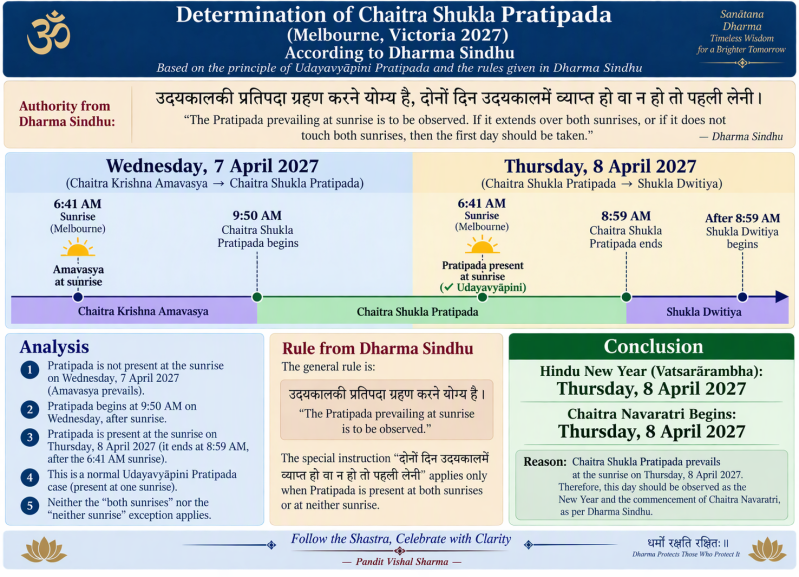
The Hindu New Year commences on Chaitra Shukla Pratipada. For determining this observance, the Pratipada prevailing at sunrise is accepted. If Pratipada extends over the sunrises of both days, or if it falls between the two sunrises and touches neither sunrise, then the earlier (first) day is to be observed.
Introduction
Dharma Sindhu establishes the method for determining the commencement of the Hindu New Year (Vatsarārambha) and the beginning of Chaitra Navaratri. The text first states the general rule and then clarifies how exceptional calendrical situations are to be resolved.
The governing principle is Udayavyāpini Pratipada, namely, the Pratipada tithi prevailing at sunrise.
The General Rule
“Udayavyāpini Pratipada” The primary instruction is: The day on which Chaitra Shukla Pratipada prevails at sunrise is observed as the Hindu New Year and the commencement of Chaitra Navaratri.
Under ordinary circumstances, this sunrise-based rule alone determines the observance.
Exceptional Cases
-
Pratipada Present at Both Sunrises (Tithi-Vṛddhi)
If Pratipada extends over two consecutive sunrises:
- Day 1 Sunrise → Pratipada
- Day 2 Sunrise → Pratipada
Dharma Sindhu directs that:
The first day should be observed.
-
Pratipada Present at Neither Sunrise (Tithi-Kṣaya Situation)
If Pratipada:
- Begins after the sunrise of Day 1, and
- Ends before the sunrise of Day 2,
then no sunrise occurs during Pratipada.
Example:
- Day 1 Sunrise → Previous Tithi
- During Day 1 → Pratipada
- Day 2 Sunrise → Dwitiya
In this situation also, Dharma Sindhu instructs:
The first day should be observed.
Summary of the Rule
- Normal Case
Pratipada at sunrise → Observe that day. - Tithi-Vṛddhi
Pratipada at both sunrises → Observe the first day. - Tithi-Kṣaya
Pratipada at neither sunrise → Observe the first day.
Conclusion
Dharma Sindhu establishes Udayavyāpini Pratipada as the primary rule for determining the commencement of the Hindu New Year and Chaitra Navaratri. It then clarifies that in the exceptional situations where Pratipada either extends across both consecutive sunrises or falls entirely between them, the observance is assigned to the first day.
Key Takeaway
The standard rule is sunrise-associated Pratipada (Udayavyāpini Pratipada). However, when Pratipada is present at both sunrises or at neither sunrise, Dharma Sindhu specifically directs that the first day be observed for Vatsarārambha and Chaitra Navaratri.